There are 3 major criteria based on which you can approximate the number of APs needed in an RF environment-
- Throughput Planning
- Capacity Planning
- Coverage Planning
Throughput Planning: This method accounts for determining the AP count based on the aggregate throughput requirement in the RF environment. The throughput requirement for each type of traffic varies significantly. The below table shows the throughput requirement based on the type of traffic.
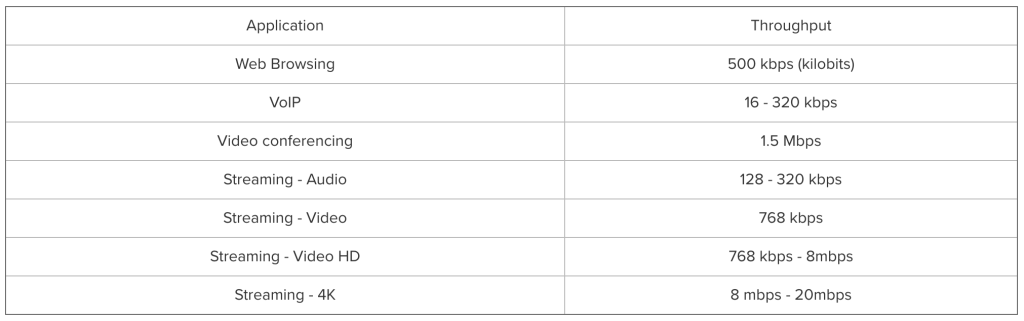
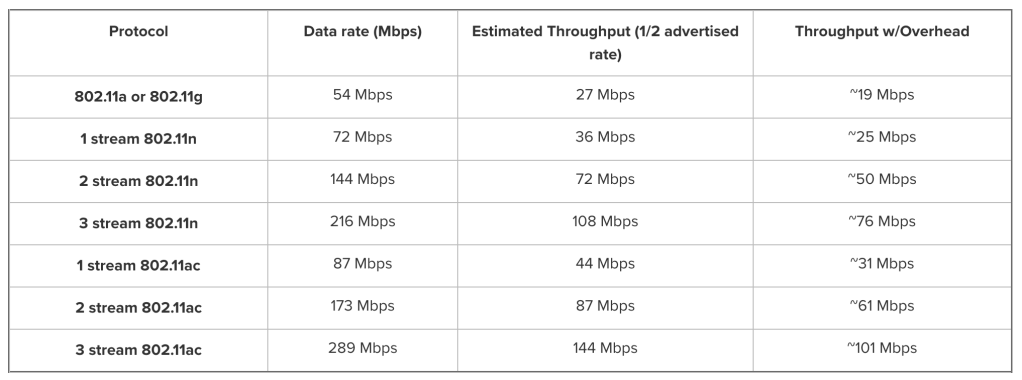
This method of determining the AP count depends on the throughput capabilities of the client devices. The client device capabilities viz. supported 802.11 protocols, number of antennas, number of spatial streams significantly affects the the throughput that the client device is capable of getting. Typically new devices are capable of 802.11 a/b/g/n if not 802.11 ac/ax. To determine the approximate AP count, one can use the following equation
AP count (based on throughput) =Aggregate application throughput/client device throughput.
The table below shows the throughput chart based on client device capability.
Capacity Planning: This method of approximating the AP count is used especially in the high density environments. A single AP should typically support 30-35 client devices such that all the clients are able to get sufficient throughput. An increase in the number of clients supported by an AP divides the airtime each client device gets significantly affecting the throughput. The solution to this kind of situation is to restrict the service area of each AP such that only 30-35 clients will be connected to it any given time.
AP count (based on device count)= Total number of 5 GHz clients connected together/25
Coverage Planning: This method only involves planning your wireless network to provide coverage within the RF environment without taking into account client count and throughput requirement. The recommended way to determine the AP count in this scenario is to use Ekahau to perform a Predictive RF Design or RF Site Survey.
A Predictive RF Design can be sufficient in office spaces or schools provided there are no significant attenuation sources or any interference agents in the environment. Certain rules I follow while determining the AP locations-
- I suggest having an AP in conference room considering the client count.
- I refrain from mounting an AP in hallways, restrooms, staircases, near elevators, reception areas.
- I typically place an AP in each classroom or two depending on the expected client device count in each of the classroom.
RF Site Survey is highly recommended in warehouses, hospitals etc. wherein there are interfering agents, attenuations sources, IoT devices.
Related Blogs
Quick Reads
Why Channel Planning is critical?
Why are network admins configuring multiple WLANs?
Comprehensive Reads
 blogscisco.com