OFDM (Orthogonal Frequency Division Multiplexing)
This is a feature in legacy Wi-Fi wherein high speed data would be transmitted over multiple subcarriers. As seen below, the total available bandwidth is divided into subcarriers and each client periodically transmits or receives data (one at a time)
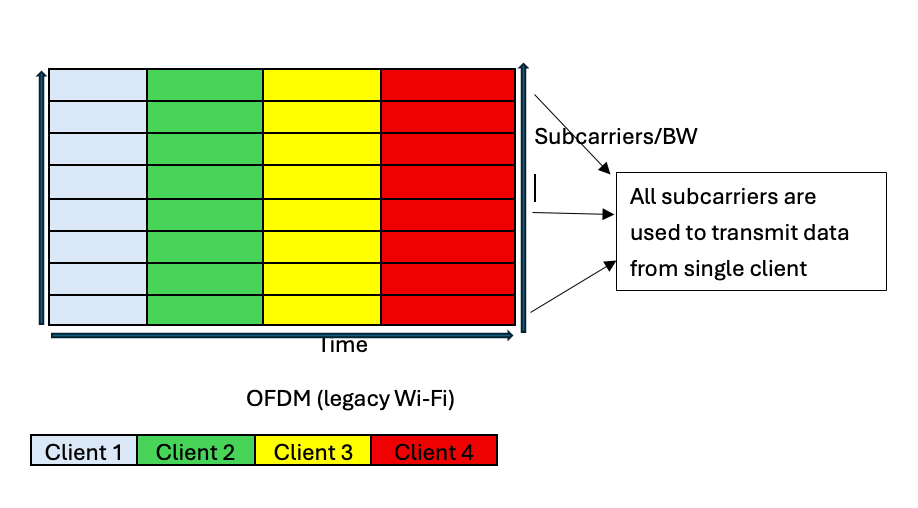
Pros-
- High speed data can be transmitted or received over multiple subcarriers.
Cons-
- Only one client can transmit or receive data at any given time.
- Multiple clients contending for bandwidth allocation will observe significant delays in transmission and could also potentially result in collisions. Real time applications like voice/video will observe significant delays in congested RF environments.
OFDMA (Orthogonal Frequency Division Multiple Access)
This is a feature introduced in Wi-Fi 6 which allows multiple clients to transmit or receive from an Access Point at the same time by sharing available bandwidth. OFDMA’s spectral efficiency improves transmission latency or delay in high congestion RF environments.
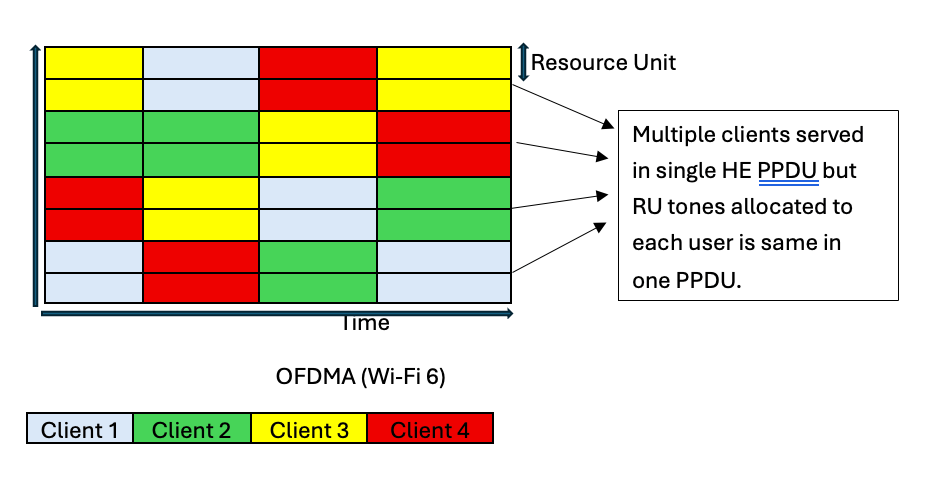
OFDMA allows sub-carriers in a channel bandwidth to be grouped into smaller portions called “Resource Units” (RU). These individual RU’s are assigned to different stations which are used to transmit and receive data.
Resource Unit Map
The below table shows the number of OFDMA users for a particular tone at any given bandwidth. It shows correlation between RUs and channel width.
| RU type | 20 MHz | 40 MHz | 80 MHz | 80+80/160 MHz |
| 26- tone RU | 9 | 18 | 37 | 74 |
| 52- tone RU | 4 | 8 | 16 | 32 |
| 106-tone RU | 2 | 4 | 8 | 16 |
| 242-tone RU | 1 | 2 | 4 | 8 |
| 484-tone RU | NA | 1 | 2 | 4 |
| 996-tone RU | NA | NA | 1 | 2 |
| 2*996- tone RU | NA | NA | NA | 1 |
Pros–
- Multiple clients can transmit or receive data simultaneously.
- Significantly reduces latency for real time applications in high congestion RF environments.
Cons-
- Same RU tone needs to be allocated to every client which results in inefficient usage of bandwidth. This will typically affect when multiple clients are sending unequal amount of data but bandwidth allocated to each client is same.
MRU OFDMA (Multi RU Orthogonal Frequency Division Multiple Access)
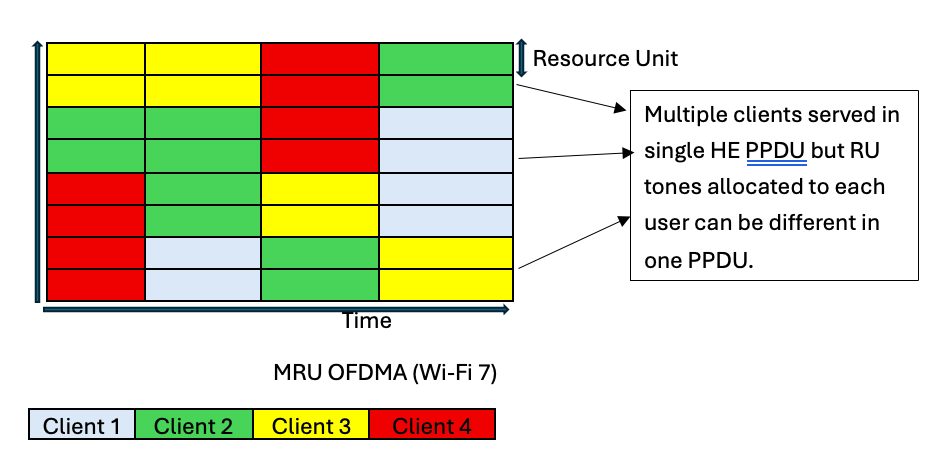
This feature is introduced in Wi-Fi 7 which allows multiple clients to transmit and receive data by sharing bandwidth and distributing the RUs equally or unequally between the clients as per the requirement.
| Wi-Fi 6 OFDMA RU allocation | Wi-Fi 7 MRU OFDMA allocation |
| RU 26 | RU 26 |
| RU 52 | RU 52 |
| MRU 26+52 | |
| RU 106 | RU 106 |
| MRU 106+26 | |
| RU 242 | RU 242 |
| RU 484 | RU 484 |
| MRU 484+242 | |
| RU 996 | RU 996 |
| MRU 996+484 | |
| MRU 996+484+242 | |
| RU 996×2 | RU 996×2 |
| MRU 996×2+484 | |
| MRU 996×2+996 | |
| MRU 996×2+996+484 | |
| RU 996×4 | RU 996×4 |
Pros-
- Multiple clients can transmit and receive data simultaneously
- MRU allows unequal RU allocation to clients participating in OFDMA this furthur enhancing performance compared to OFDMA (Wi-Fi 6)
Related Blogs
Dynamic Frequency Selection (DFS)
Dynamic Frequency Selection (DFS) Concepts

